There’s a moment, just before sleep, when the room finally settles. The lamp is low. The duvet smells faintly of sun-dried linen. Nothing in the corner of the eye is asking for attention. That moment is the whole point of a bedroom — and it’s the one most of us design last. This slow living bedroom guide keeps the focus on proportion, maintenance, and how the room feels in daily use.
In our room edits, the change works only when it solves a visible problem instead of adding another layer to manage. Use the same restraint behind DIY linen curtain and single good vase: measure first, repeat materials deliberately, and leave enough blank space for the change to read.
This guide walks through five quiet, almost imperceptible decisions that compound into a room you actively want to be in at the end of the day.
Start with the bed, then stop
The bed is 60% of the visual weight of any bedroom. If it looks calm, the room looks calm. We default to a single fitted sheet, a stonewashed flat sheet folded back, one duvet, two pillows. That’s it. The trick is that “more layers = more cosy” is a Pinterest-era myth — three pillows photograph well and feel busy in person.
For this choice, this section matters most when it is checked from the doorway and from the seat or counter where the decision will be seen every day. Give the idea at least 24 hours in normal morning and evening light, then remove one nearby object before deciding whether the room needs anything else.
Lower the light, raise the warmth
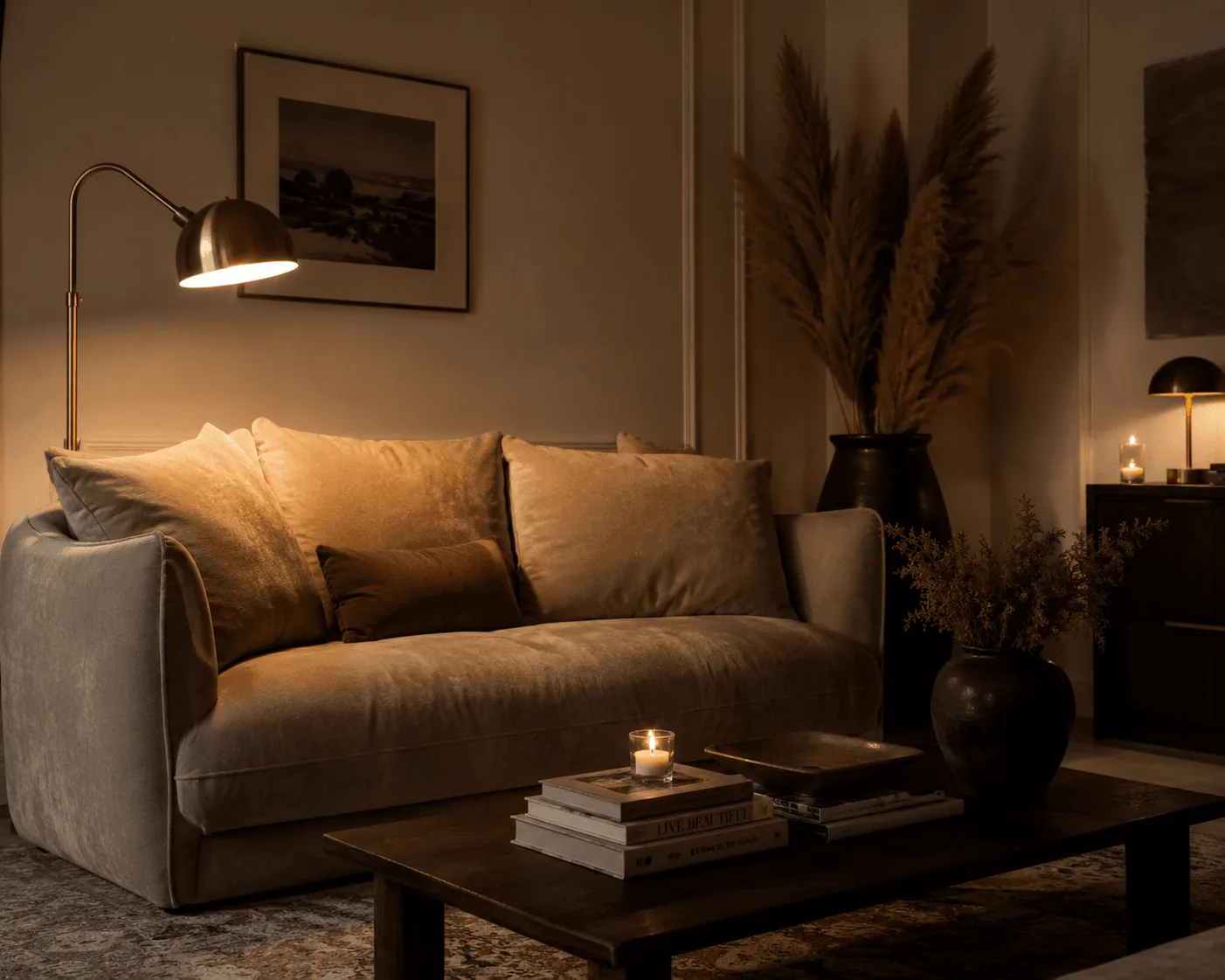
Two 2700K table lamps will out-perform any overhead fixture in a bedroom. If you can put them on dimmers, do. The goal isn’t dim — it’s warm and directional, so shadows soften the corners of the room instead of erasing them.
For the broader principle of light temperature in residential spaces, see our guide to three lighting upgrades under $70.
A bedroom isn’t a stage. The light should fall off the room, not flood it.
For this choice, this section matters most when it is checked from the doorway and from the seat or counter where the decision will be seen every day. Give the idea at least 24 hours in normal morning and evening light, then remove one nearby object before deciding whether the room needs anything else.
Choose one texture and repeat it
Linen, boucle, washed cotton — pick one and let it carry. Linen on the bed, linen on the curtains, a linen-upholstered chair in the corner. It reads as intentional rather than coordinated.
Practical note on linen
If you’re new to it, expect creases. They’re the point. Iron the pillowcases if you want sharp; leave the duvet alone.
Take something away every season
A working rule we use with clients: every March and October, remove one decorative object. Not move — remove. Bedrooms accumulate. Vases, books-meant-to-be-read, a third candle. Editing twice a year is what keeps a “warm” room from becoming a “busy” one.
For this choice, this section matters most when it is checked from the doorway and from the seat or counter where the decision will be seen every day. Give the idea at least 24 hours in normal morning and evening light, then remove one nearby object before deciding whether the room needs anything else.
End the day where you started it
The last design decision is the simplest: keep nothing on the nightstand that isn’t actively useful tonight. A glass of water, a paperback, a low light. That’s the room.
The best bedrooms aren’t decorated. They’re allowed to recede.
For this choice, this section matters most when it is checked from the doorway and from the seat or counter where the decision will be seen every day. Give the idea at least 24 hours in normal morning and evening light, then remove one nearby object before deciding whether the room needs anything else.
The bedside audit
The fastest way to understand a bedroom is to look at the bedside tables. They reveal whether the room is designed for rest or for accumulation. A good bedside table has one light source, one active book or notebook, water, and maybe one small dish. Everything else is a delayed decision.
If you need storage, choose a table with a drawer rather than adding baskets underneath. Visible storage under a bedside table creates a low band of clutter exactly where the room should feel quietest. The area closest to the pillow should be the least visually demanding area in the room.
Colour temperature and sleep
Warm neutrals fail when the bulbs are wrong. A taupe wall under a 4000K bulb can look grey-green; a linen duvet under the same light can look dingy. Keep bedroom bulbs at 2700K and avoid exposed cool LEDs in wardrobes or vanity mirrors unless they are on a separate task switch.
Layer the light instead of increasing wattage. One lamp on each side of the bed, both shaded, is more comfortable than one bright ceiling fixture. If the room needs reading light, add a directional sconce or clip lamp so the general light can stay low.
Storage that keeps the mood
Warm-neutral bedrooms need closed storage. Open rails and visible shoe racks are practical in some flats, but they make rest harder because the room is constantly showing you tomorrow’s decisions. If closed storage is not possible, use a curtain in the same colour family as the wall so the storage reads as architecture.
Seasonal rotation helps too. Keep only current bedding in the room. Spare duvets, extra throws, and summer sheets belong in a labelled box elsewhere. The fewer soft goods competing in the bedroom, the more the linen you actually use can define the space.
What to buy last
Buy art last. Bedrooms often feel unfinished, and art looks like the obvious answer, but the unresolved feeling is usually lighting, bedding proportion, or storage. Once the bed, light, and bedside surfaces are calm, you may find the wall needs nothing more than a single small piece or a textile above the headboard.
If you do add art, avoid high-contrast gallery walls in the sleep zone. One quiet print, one textile, or one framed photograph is enough. The bedroom is allowed to be less visually interesting than the rest of the house. That is part of its job.
How to Use Slow living bedroom at Home
Start with measurements rather than mood. Mark the likely footprint with painter’s tape, books, or a folded towel before buying or rearranging anything. A useful rule is to leave at least 60 cm for a main walkway, 35-45 cm between a sofa and coffee table, and 10 cm of visible border around small textiles or objects that sit on the floor. Those numbers are not decorative; they decide whether the idea feels calm once people actually move through the room.
Check the material against what is already present. If the room has several glossy surfaces, add matte texture. If it has many pale fabrics, add one grounded wood, stone, black, or brass note. If it already has strong contrast, keep the new piece quieter. The goal is not to match every finish, but to repeat one material family so the choice feels connected to the room instead of dropped into it from a product photo.
Plan maintenance before styling. Anything near water, food, pets, children, or direct sun needs a cleaning rhythm and a tolerance for wear. Soft textiles may need weekly washing, stone may need coasters, acrylic may need microfiber cleaning, wood may need pads under objects, and lighting may need a dimmer that is compatible with the fixture. A beautiful choice that is annoying to maintain usually becomes visual clutter within a month.
Use the one-in, one-out test after the change lands. Add the new piece, then remove one smaller object in the same sightline. If the room feels more intentional, leave the smaller object out. If the room feels bare, return it after a week. This keeps the edit from turning into accumulation and protects the calm that made the change worth considering in the first place. Used this way, slow living bedroom becomes part of the room’s structure rather than a loose accent.
FAQ
How do I use this idea without making the room feel busy?
Use the change as one clear decision, then remove or quiet the nearest competing object. The room should gain a job, a material note, or a focal point rather than another small thing to maintain.
What should I measure before choosing it?
Measure the available width, depth, height, and the walkway that remains after the piece or idea is in place. For most rooms, 60 cm of clear passage and visible breathing room around the object prevents a styled choice from becoming an obstacle.
Can this work in a rental or small home?
Yes, if the choice is reversible and scaled to the room rather than the product photo. Freestanding pieces, textiles, plug-in lighting, removable hooks, and careful styling usually give the best result without changing the building.
What is the most common mistake with this idea?
The common mistake is treating the idea as decoration before checking proportion and maintenance. If the size is wrong or the material is hard to live with, even an attractive choice will make the room feel less settled over time.